
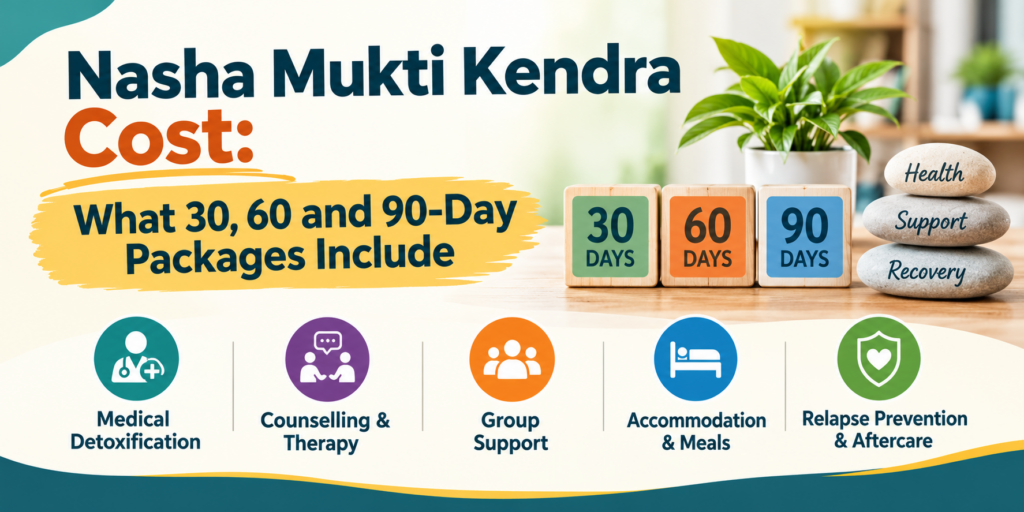
How much will it cost? is nearly always the first thing a family asks on the phone. Then there’s a pause, and out comes the second question: “And what does that actually cover?
That second one is the one to focus on. I’ve seen two centres quote the same amount for 30 days, where one includes doctor visits, medicines and family counselling, and the other bills for each of those separately. By the end of the month, the “cheap” option has quietly become the expensive one.
So this post is about how Nasha Mukti Kendra really adds up, and what changes when you go from 30 days to 60 or 90. I haven’t listed exact rupee figures, because fees depend on the person, the room and the treatment plan, and quoting a number that doesn’t fit your situation would only mislead you. If you want a real quote, the number to call is at the end.
What’s inside a package
Think of a package as a basket, not a single item. Most baskets hold a bed and meals, doctor or psychiatrist visits, nursing care during detox, counselling, and some form of daily routine such as yoga or meditation. Many also include family sessions and basic blood tests. Medicines are the item that moves around the most. Some centres include these expenses in the total fee, while others charge them separately later.
When a quote lands on WhatsApp as one bare number, reply and ask what’s in it. If they can’t tell you, that’s already useful information.
Why one centre costs double another
Families get confused here, and fairly so. Same duration, wildly different prices. A few things drive the gap.
Staffing is the biggest. A resident doctor and trained psychologists cost real money. A part-time visiting doctor and a single counsellor cost far less, and you’ll feel that difference when a patient has a bad night. The building matters too. Clean rooms, proper beds and a working kitchen aren’t free to run. Then there’s the person being treated: someone with heavy alcohol dependence, a damaged liver or untreated depression needs more monitoring and more tests than someone with a milder problem. And of course a private room costs more than a shared one.
None of this means expensive equals good. A low price should make you ask what’s missing, and a high price should make you ask what you’re getting for it.
The 30-day package
Thirty days is the shortest stay most centres offer. It usually covers the toughest opening stretch: assessment, supervised detox, and the first few weeks of counselling.
It suits some people well. Maybe the dependence is fairly recent, or the person has been through treatment before and needs a short reset, or the family can only commit to a month right now.
When you get a 30-day quote, ask three things. Is detox medication included? How often are counselling sessions scheduled throughout the week? And what’s the plan for week four? Some centres have a clear step-down plan. Others simply hand the person back to the family on day 31.
Four weeks may help someone regain stability, while deeper emotional healing often begins near the end of that period. Our post on how many days treatment takes at a Nasha Mukti Kendra covers this properly.
The 60-day package
With 60 days, there’s room to breathe after detox. Sleep settles, the fog lifts, and the real work on triggers, habits and family tension can begin.
It tends to fit people who’ve quit before and slipped, people with a longer history of use, and anyone whose home environment makes an immediate return risky.
Don’t assume the price is simply double. Some centres lower the daily rate for longer stays, since the initial assessment and detox set-up costs get spread over more days. Others charge the same per day regardless. It’s worth asking which way your centre works.
The 90-day package
Ninety days is the longest standard option, and it gives the most time for recovery to take root. The person can build routines, attend therapy regularly, bring the family into the process and plan for life after discharge.
Medical professionals may recommend it for serious or prolonged substance dependence, recurring relapses, or situations involving anxiety or depression that also require care. But the length should come from an assessment of your relative, not from a salesperson aiming for the biggest bill.
If anyone recommends 90 days, ask why. A good answer mentions your relative’s history, health and progress. A weak answer is “it’s our standard programme.”
Comparing two quotes, with some made-up numbers
Here’s a quick illustration. These figures are invented, only to show the sums, and aren’t anyone’s real rates.
Say you get two quotes for 60 days. Centre A asks for ₹90,000 and includes food, a shared room, doctor visits, medicines and weekly family sessions. Centre B asks for ₹70,000, but medicines (₹12,000), tests (₹5,000) and family sessions (₹6,000) are all extra.
Add it up and Centre B comes to ₹93,000. It looked cheaper, and it wasn’t. That’s why the number to ask for is the total you’ll pay, not the starting price.
Another useful trick is to divide by days. A longer package with a lower daily rate can work out better than two shorter stays, as long as your relative genuinely needs the extra time.
The charges people forget to ask about
Some costs only show up after admission, and by then it’s awkward to argue. So ask up front about registration or admission fees, security deposits and whether they come back, changes in medicines, lab tests, emergency hospital transfers, travel or escort charges, and extra fees for private rooms or special diets. Ask about the additional charges if the treatment period needs to be extended beyond the original plan.
Whatever the answers are, get them written down. A centre worth trusting will hand you an itemised sheet without you having to chase it.
What if someone chooses to leave treatment before their planned discharge date?
Real life rarely follows the calendar. Someone feels better on day 20 and wants to go home. Someone else needs three extra weeks. Both happen all the time.
Before you pay, find out how refunds work if the patient leaves early, and whether the daily rate stays the same if you extend. Having this on paper saves you from an argument at the worst possible moment.
Aftercare costs, too
The bill doesn’t always stop at discharge. Follow-up visits, medicines, counselling and support group meetings take time and sometimes money. Ask what the centre offers after the stay, and whether that’s part of the package or billed separately.
It also helps to look at the other side of the ledger. Ongoing alcohol or drug use eats money in quiet ways: daily spending, missed work, medical bills, sometimes legal trouble. That doesn’t make treatment cheap. It does help families see the figure in proportion.
Get a clear quote before you decide
At Jeewan Disha Foundation, we’d rather you understand every line of the cost than be surprised later. You can visit our Mandoli, Delhi centre, explore the facilities, meet our staff and discuss each treatment package before making your decision.
Know more about – Government-Approved vs. Uncertified Rehab Centres