
Picture a father in Delhi. His son’s friend has just called to say the boy has been drinking for days and his hands won’t stop shaking. By evening the father has three numbers from a Google search, a fee quote on WhatsApp, and a bed “available tonight.” He doesn’t ask for a licence. It doesn’t cross his mind.
We see families in exactly this spot. When fear sets in and time feels limited, the first Nasha Mukti Kendra to answer the call often gets chosen. But ten minutes of questions before admission can save your relative a lot of harm, and save you a lot of money too.
So what does “government-approved” really mean?
Honestly, it depends who’s saying it. Centres use the phrase for three very different situations.
Some are government-run, like the de-addiction wards inside public hospitals and medical colleges. Others are private or NGO-run but get grants under a central or state scheme. And many, probably most, are private centres that are simply registered to operate in their state.
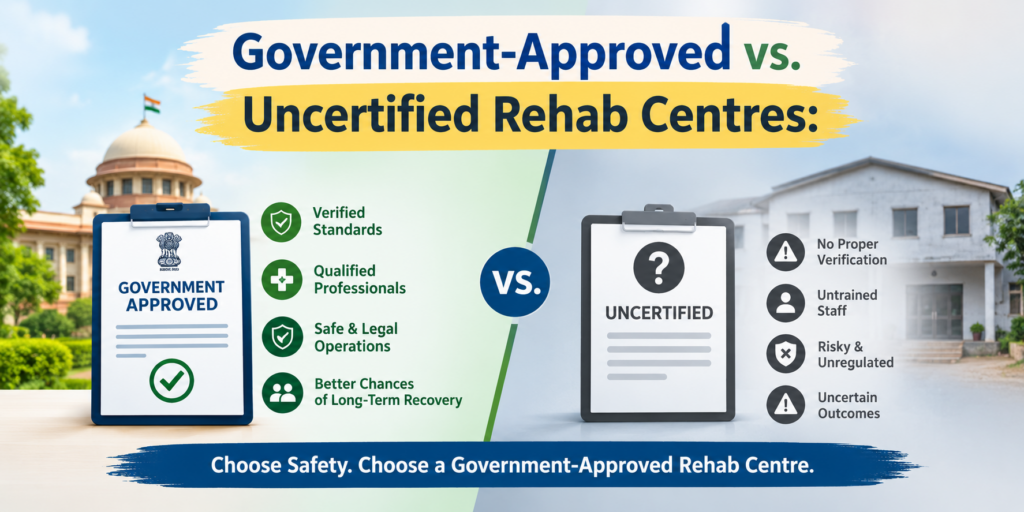
Under the Mental Healthcare Act, 2017, places that treat mental health conditions are expected to register with the State Mental Health Authority. Substance dependence falls under that. Some states layer their own clinical establishment rules on top, so the exact paperwork changes depending on where you are. Call the state authority and ask what a legal centre in your area must hold.
If a brochure says “government recognised” but gives no registration number and doesn’t name who issued it, it tells you nothing.
Why bother with paperwork at all?
A certificate won’t treat anyone. That’s true. But it puts the centre inside a system where someone can inspect it, ask questions and hold it accountable.
Say a patient has a seizure at 3 am and there’s no doctor in the building. Or the fee quietly doubles in week two. With a registered centre, you have somewhere to complain. With an uncertified one, you have the owner’s goodwill and nothing else.
This matters most with alcohol and sedatives. Withdrawal from these can turn serious fast, and a place without real medical cover can’t handle it.
What you can ask to see
You’re allowed to ask. A decent centre won’t be offended, and some will show you before you’ve even finished the sentence. Ask for the registration certificate and read the number, the issuing authority and the expiry date. Make sure the name and address match the building you’re standing in. Ask for the doctor’s qualifications and their medical council registration. Find out who the counsellors are and what training they’ve had. Get the fees in writing, including what’s extra. And read the admission and consent form before anybody hands you a pen.
If the reply to any of this is “we’ll sort it later,” take that as your answer.
Red flags that should slow you down
Bad centres don’t always look bad. Some have slick websites and very sweet receptionists. So watch for things like these:
A promise to cure someone in 15 or 30 days. A “doctor” who only visits when called. Pressure to pay a big amount today. A flat refusal to show you the rooms or the kitchen. Patients who can’t phone home for weeks. Tablets handed out with no prescription and no explanation. A programme that sounds like it’s about “teaching him a lesson” rather than treating him.
India has had reports over the years of people being locked up, beaten or starved in unregulated centres. Punishment isn’t treatment. It also tends to make a person even less willing to ask for help next time.
A licence is where you start, not where you stop
Being registered means a centre has cleared the minimum. It doesn’t tell you whether the place is good. For that, you need to go and look.
Pay attention to the atmosphere. Do the patients seem settled, or do they flinch when staff walk past? Is there a real daily routine with therapy, meals and rest? When you speak to the doctor, do they explain things in plain words? Do the counsellors ask about your relative’s history, or do they describe one standard programme that everyone gets?
Then ask a blunt question: what happens if someone has a fit tonight? A good answer names the doctor on call and the hospital nearby. A woolly answer is its own warning.
What if a person refuses to seek help or is unwilling to enter a treatment centre?
Plenty of families admit a relative who’s refusing. It’s a painful decision, and you may feel there’s no choice. Still, how the centre handles it matters.
Ask what they do when a patient says no, or wants to leave. A responsible centre will talk it through with the family and follow the law. It won’t snatch phones, bolt doors or keep someone against their will. Even a reluctant patient is entitled to privacy and decent treatment.
If your relative is already inside and something feels off
Don’t wait and hope. Go in person and ask to see the patient, even for five minutes, ideally with nobody listening. Ask for the registration papers and the doctor’s details in writing. Ask what medicines are being given, and why. If you suspect abuse or illegal confinement, contact the local police or the State Mental Health Authority.
One caution, though. Never interrupt detox treatment midway without first consulting the treating doctor. Leaving mid-withdrawal can be just as risky as staying in a poor centre. Get a second opinion, perhaps from the psychiatry department of a government hospital, and move the person safely.
Take the extra day if you have it
Rushed choices cost the most. If you can spare even a day, shortlist two or three centres and put the same questions to each. Notice how they react when you ask for documents. A centre that’s slow or irritated about that is unlikely to be open with you after admission either.
At Jeewan Disha Foundation, we’d rather you ask hard questions than sign in a hurry, whether you pick us or someone else. You’re welcome to visit our centre in Mandoli, Delhi, meet the team and see the place first, before you decide anything.
Call +91-8506800368 to talk to our team and ask about our treatment process, with no obligation to admit.
Believe what you can check
Looking for treatment for someone you love is stressful enough. You shouldn’t also have to wonder whether the place is safe. A registered centre with qualified staff, clear costs and open doors gives recovery a steady start. An uncertified one asks you to trust it blindly.
So check the registration. Meet the doctor. Walk through the rooms. Read every form. If a centre makes any of that hard, move on. And if you’d like to talk through what a Nasha Mukti Kendra should offer, Call +91-8506800368 and we’ll help, without pressure or hurry.
Pingback: Nasha Mukti Kendra Cost: 30, 60 & 90-Day Rehab Package Breakdown